|
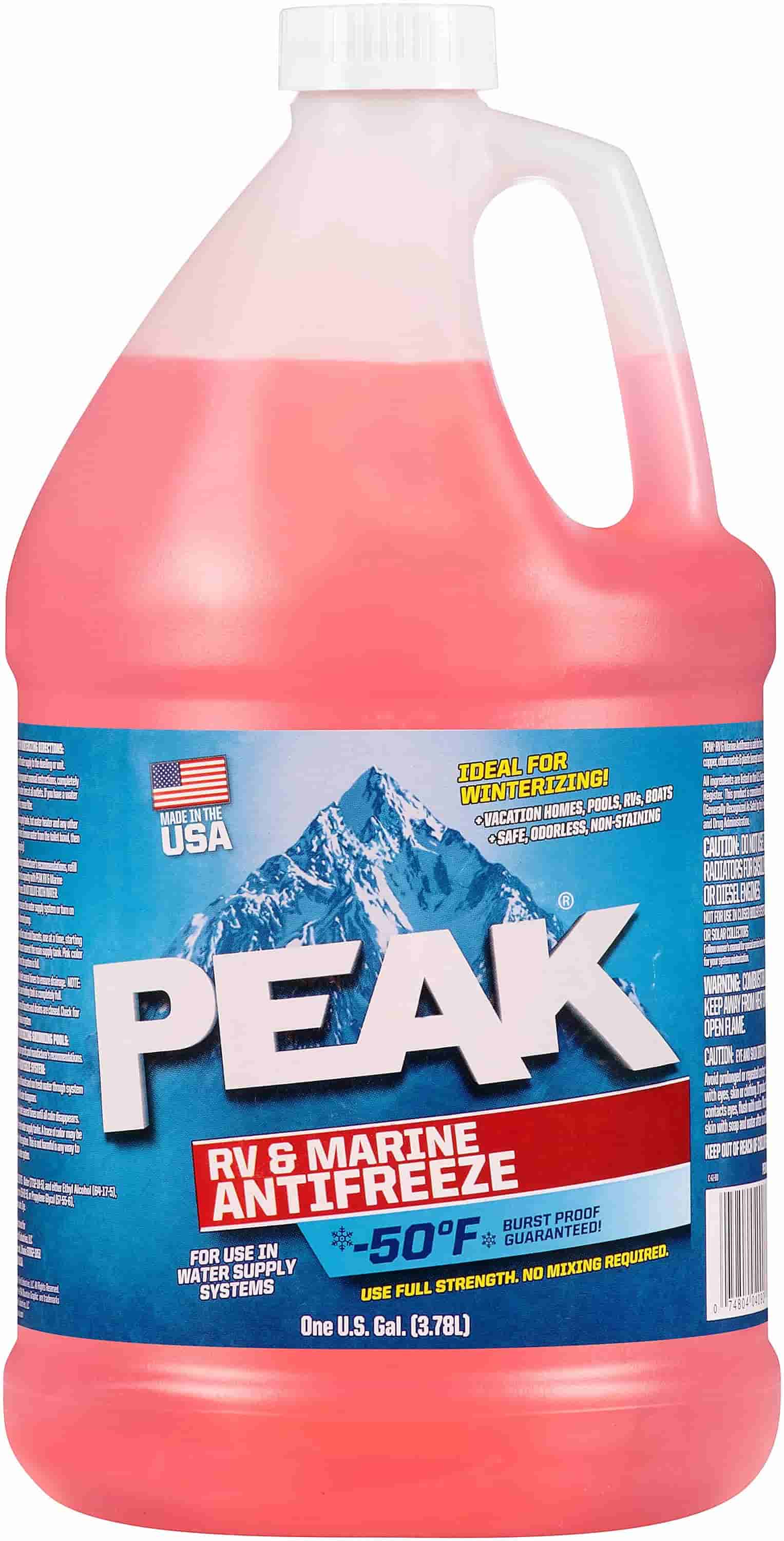
Propylene glycol (PG) antifreeze comes in two types, motor vehicle and RV. These antifreezes are intended for completely different end uses. This paper will discuss the applications and differences between these antifreezes. RV antifreeze also known as RV/Marine antifreeze is intended to protect both drinking and waste water systems in recreational vehicles and seasonal homes. It is also used to winterize marine engines which prevents them from bursting while in storage for the winter. Although While -50°F RV/Marine antifreeze will start to freeze at about 10°F it will not burst until -50°F. This is known as burst protection. Burst protection to -50°F is achieved with less than a 35% PG solution. For this reason most RV antifreezes come pre-diluted with as much as 65% water. RV/Marine antifreeze is also intended to protect drinking water systems from rusting. Drinking water systems are composed mainly of steel piping. Because of the contact with drinking water pipes, a non toxic corrosion inhibitor such as Di-Potassium Phosphate is used in fact it is the only corrosion inhibitor found in most RV/Marine antifreeze. Also, since RV/Marine antifreeze is intended to be flushed out seasonally, the corrosion inhibitors are not designed for long-term protection. RV/Marine antifreeze is not formulated for use
in automotive and light/heavy duty vehicles. In these
applications, a coolant specifically formulated to protect engines
and cooling systems against rust, corrosion and freeze/boil over
protection should be used. Motor vehicle antifreeze is intended to
protect the cooling system in a car or truck from corrosion for a
period of 2-3 years. As a result, the corrosion inhibitors are
much more expensive. |
|
Ethylene or
Propylene Glycol Based Antifreeze | Antifreeze
with Phosphate Inhibitors |