click here for home
Our Products
PEAK Promotions
PEAK Racing
Store Locator
Site Map


Frequently Asked Questions


A. Why is it important to mix antifreeze with water?
Antifreeze contains chemicals that protect your engine against rust and corrosion, as well as freeze-up and boil over protection. Water is required to activate the chemicals in the inhibitor package. Furthermore, adding water to antifreeze actually increases the freeze-up and boil over protection provided. For example, a mix of 40% antifreeze and 60% water provides freeze-up protection down to -10°F and boil over protection up to 259°F. In comparison, a mix of 70% antifreeze and 30% water provides freeze-up protection down to -62°F and boil over protection up to 270°F. However, we do not recommend adding more than 70% antifreeze. This would limit the corrosion and freeze up protection and heat transfer capabilities of the antifreeze. 

back to top


B. Can I mix ordinary tap water with antifreeze?

Yes, tap water is commonly used for mixing with antifreeze, however, deionized water or distilled water is preferred. Do not use water softened with salts to mix with antifreeze. 

back to top


C. Why does my vehicle owner’s manual recommend a phosphate free antifreeze?

Some European car manufacturers recommend that phosphate free antifreeze be used in their vehicles. The reason is that the water in Europe has an extremely high mineral content. If you mixed an antifreeze containing phosphates, which are part of the corrosion inhibitor package, with the water they have in Europe, the phosphates in the antifreeze may “drop out” and form deposits in your cooling system that can lead to corrosion. However, this is not a major concern in North America, since our water is lower in mineral content, or softer, than European water.If you are interested in a phosphate-free antifreeze, Old World Industries offers PEAK® Global LifeTime™ Antifreeze and SIERRA®, the Safer Antifreeze.  

back to top


D. What makes SIERRA Antifreeze safer?

SIERRA Antifreeze is a premium quality, propylene glycol (PG) based antifreeze that provides engine protection comparable to that provided by premium conventional ethylene glycol (EG) based coolants. 

However, because of its PG formulation, SIERRA Antifreeze is less toxic than conventional EG based antifreeze and, therefore, safer to pets, people and wildlife in cases of spills, leaks, boil-over, or careless disposal.  

back to top


E. Can I mix SIERRA Antifreeze with an ethylene glycol based antifreeze?

SIERRA Antifreeze is compatible with ethylene glycol based (EG) antifreeze. If they are accidentally mixed, no damage to the cooling system will occur. However, due to the toxicity of the EG antifreeze, mixing antifreeze will eliminate the safety advantages of SIERRA Antifreeze.  

back to top


F. What is the shelf life of antifreeze?

If the product is still in the original sealed container, then it has a shelf life of many years. We recommend that antifreeze be used within one year of purchase.

back to top


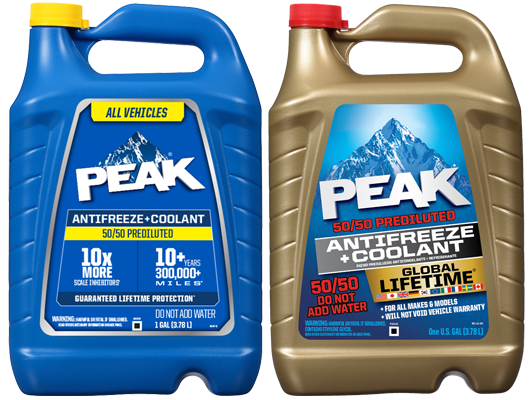
G. What is PEAK Global LifeTime Antifreeze & Coolant?

PEAK Global LifeTime Antifreeze & Coolant features a patented, advanced organic acid technology that provides guaranteed LifeTime protection - for as long as you own your vehicle!* Its patented inhibitors will provide maximum protection against damaging rust and corrosion in all automobiles and light trucks worldwide, regardless of make, model, year or original antifreeze color.
* See warranty link below on footer (peak global lifetime warranty)

back to top


H. How should I dispose of used antifreeze?
All laws and regulations should be observed when disposing of Antifreeze/Coolant and Radiator Fluids. Call the EPA or the office of your state or local environment agency for details on disposal procedures.

back to top


I. What is the proper mixture of antifreeze to water for adequate freeze protection in my area?
While temperatures and climates vary, most vehicles can use our conventional antifreeze protection chart.

back to top